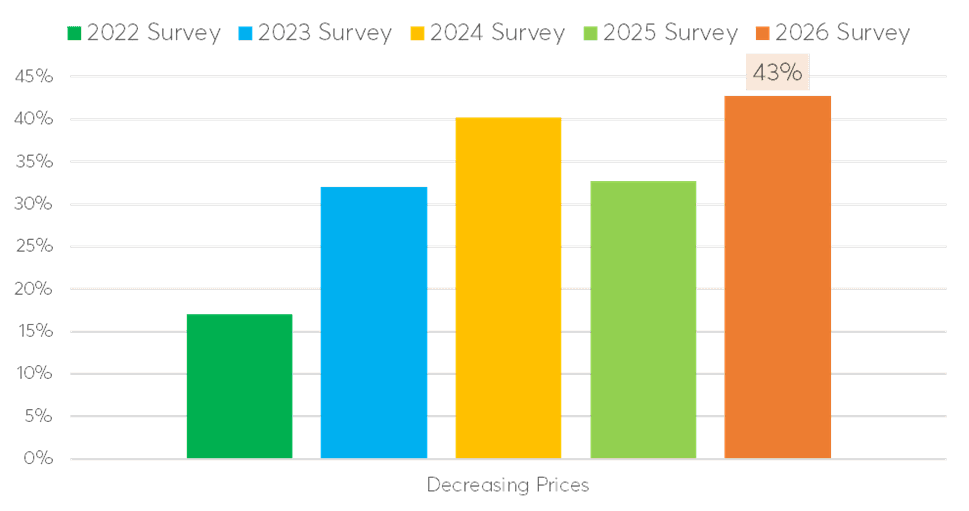
Mortgage information asymmetry is evaporating at an accelerating pace, driven by mass consumer adoption of artificial intelligence tools. Institutions that don't adapt will lose their most valuable clients without even noticing, while those who understand this structural shift can build stronger, more profitable relationships.
The Big Picture

For most of mortgage's recent history, lenders operated with a fundamental structural advantage: borrowers didn't know what they didn't know. Most arrived at the process without fully understanding pricing options, available programs, or what their credit profile actually entitled them to. This asymmetry allowed for wider margins and less transparent processes, creating an ecosystem where the lender's specialized knowledge was the primary barrier to effective comparison shopping.
That advantage is eroding faster than most executives have accounted for in their strategic plans. Generative AI has created a 24/7 research partner that's becoming increasingly fluent in mortgage language—from technical terms like "PMI" and "LTV" to complex credit optimization strategies. This isn't a passing technological curiosity but a structural shift in consumer behavior with profound competitive implications. What happened to other industries is instructive: Zillow didn't eliminate real estate brokerages—it eliminated those whose primary value was information access. The ones that thrived repositioned around execution, interpretation, and service complexity.
The change is particularly significant in mortgages because the product is highly complex, personalized, and emotionally charged. A typical mortgage involves dozens of interrelated variables, from credit scores and debt-to-income ratios to government programs and adjustable interest rates. Historically, only professionals with years of experience could navigate this complexity effectively. Today, tools like ChatGPT, Claude, and specialized personal finance assistants are democratizing this knowledge at unprecedented speed.

“AI is shifting negotiating power from lenders to borrowers at scale, creating a market where transparency is no longer a competitive advantage but a basic expectation.”
By the Numbers

- AI Research: 20% of consumers have already used AI for loan or mortgage research, according to 2025 data, with projections indicating this percentage could double by late 2026.
- General Financial Usage: 59% of consumers are using AI at least occasionally for banking and financial services, including statement analysis, investment planning, and debt optimization.
- High-Income Adoption: Households earning more than $100,000 per year show particularly strong use, with adoption rates exceeding 35% in this demographic segment.
- Real Credit Impact: On a $500,000 purchase with 10% down over 30 years, the difference between a 689 and 740 credit score represents $301 less per month in payments, or approximately $108,360 less in interest over the loan's life.
- Research Time: Borrowers using AI spend on average 40% more time on pre-application research than non-users, arriving at initial conversations with more specific questions and clearer expectations.
- Offer Comparison: 72% of AI users for mortgages request quotes from multiple lenders, compared to only 48% of non-users.
Why It Matters
The most valuable borrowers are arriving at the point of sale better prepared than ever. These aren't marginal customers but those with the highest purchasing power and financial sophistication—exactly the segment that generates the greatest profitability for mortgage institutions. When a borrower has modeled their scenarios with AI—knowing what their credit score entitles them to, what rates are available, and what a fair deal looks like—they're evaluating the loan officer and their offer against a baseline they brought with them.
The most significant near-term risk isn't the borrower who actively pushes back on an offer. It's the borrower who leaves without a word. Client production data shows loan officers who proactively produce a credit optimization plan close at materially higher rates than those who don't. The explanation isn't that optimization improves every outcome, but that borrowers who don't receive a plan are more likely to shop—and the borrowers most likely to shop are also the most creditworthy, financially sophisticated, and valuable.
The strategic implication is clear: value no longer resides in possessing information, but in interpreting and applying it in ways that exceed the informed borrower's expectations. A loan officer who merely confirms what the client already knows through AI is on the path to irrelevance. Instead, those who can identify opportunities that AI might miss—such as special programs for certain professions, market timing strategies, or specific tax considerations—will build lasting relationships.
What This Means For You

For mortgage institutions, this represents an urgent wake-up call. Standard transactions are getting commoditized, and firms that built their business on volume without differentiation will get squeezed. The exposure is greater in mortgages than in other industries because information asymmetry has historically been a larger share of the value proposition here. However, this crisis also presents significant opportunities for those willing to transform their operations.
- 1Reassess your core value proposition: If your primary advantage was information access, you're at critical risk. Reposition around execution, interpretation, and handling complexity. Develop consulting services that go beyond the transaction, such as home-related estate planning, accelerated payoff strategies, or long-term refinancing analysis.
- 2Train your team for the new reality: Loan officers must become consultants who exceed, not just match, the research borrowers have already done. This requires training in areas like complex scenario analysis, mortgage tax optimization, and deep understanding of niche programs that general AI tools might overlook.
- 3Implement proactive and predictive tools: Develop systems that identify credit optimization opportunities before borrowers discover them on their own. This includes algorithms that analyze credit histories to suggest specific improvement actions, tools that model multiple debt structuring scenarios, and platforms that facilitate transparent option comparison.
What To Watch Next
AI adoption for financial research will continue accelerating through 2026, with increasingly mortgage-specific tools emerging in the market. Second-quarter data will show whether close rates are diverging between institutions that have adapted and those that haven't—a gap that could widen rapidly as more consumers adopt these technologies.
Also watch for industry-specific AI tool development that could help lenders stay one step ahead. These include platforms that analyze borrower behavior patterns to predict needs, systems that automate personalized documentation, and algorithms that optimize loan structuring in real-time based on market changes.
Regulations around AI use in credit decisions will also evolve significantly in 2026. Any regulatory changes could alter the competitive dynamics, potentially leveling the playing field or creating new barriers for smaller players. We're likely to see increased scrutiny on algorithmic transparency, explainability requirements for AI-assisted credit decisions, and standards to prevent bias in optimization tools.
The Bottom Line
The information advantage that long defined the mortgage industry is disappearing irreversibly. Institutions that restructure their workflows and tools to meet that reality won't just survive—they'll grow by capturing greater share of the informed, high-value borrower market. The ones that don't will feel it in pull-through rates before they understand why, gradually losing their most profitable clients to more agile competitors.
Watch how leading institutions respond over the coming quarters, particularly in their technology investments, training programs, and role redefinitions. Prepare for a market where informed borrowers are the norm, not the exception—and where success will depend on the ability to add genuine value beyond what any AI tool can provide on its own. The next phase of the mortgage industry belongs to those who understand that in a world of abundant information, true competitive advantage resides in applied wisdom, not accumulated knowledge.